
|
Jinji Quiambao, Newsbytes.ph 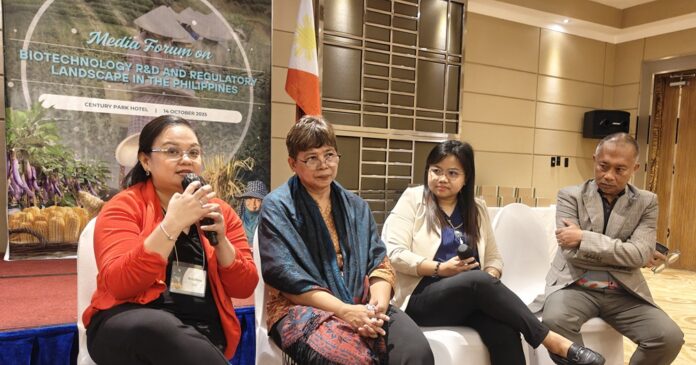 Photo shows (from left) Kristine Tome; program officer II at ISAAA; Dr. Lourdes Taylo, Bt Eggplant program head at IPB UPLB; Dr. Clarrise Gonzalvo, assistant professor 7 at CDC UPLB; and Joy Bartolome Duldulao, branch director for healthier rice program co-lead at PhilRice As climate change and food insecurity continue to challenge the nation’s agricultural productivity, Filipino scientists are turning to biotechnology (BT) as a key solution for sustainable farming and nutrition. At a media forum on “Biotechnology R&D and Regulatory Landscape in the Philippines” held on October 14, experts from leading scientific institutions reported significant advances in gene-edited and genetically engineered crops— innovations poised to reshape the country’s food systems. The International Service for the Acquisition of Agri-biotech Applications Inc. (ISAAA) noted a growing global and local acceptance of gene-edited crops, driven by more science-based regulations. These crops — engineered for higher yield, pest resistance, and improved nutrition — are seen as vital in addressing malnutrition and climate-related farming losses. The Philippine Rice Research Institute (PhilRice) has shifted its research priorities from merely increasing yield to improving eating quality and nutritional value. One example is Golden Rice, a genetically engineered variety enriched with Vitamin A to combat micronutrient deficiency among Filipino children. At the University of the Philippines Los Baños (UPLB), researchers from the Institute of Plant Breeding (IPB) continue to advance Bt eggplant and Bt corn, crops modified for resistance to major pests such as the fruit and shoot borer and corn borer. These biotech varieties reduce the need for chemical pesticides, lowering farming costs and environmental risks. Despite these scientific milestones, experts warn that regulatory hurdles remain a bottleneck. Legal challenges, including environmental cases such as Writ of Kalikasan petitions, have delayed commercialization and farmer access to biotech crops. “The science is ready, but the system must keep up,” said Dr. Winifredo Dagli of UPLB’s Department of Science Communication. “We need stronger science communication and policy alignment to make biotechnology truly work for the people.” A UPLB study also underscored the need for science education and public engagement to dispel misinformation and build trust in biotechnology. Experts urged the government and private sector to share success stories from other countries and make scientific concepts more understandable to farmers and consumers alike. Forum participants — including PhilRice, UPLB, the Department of Agriculture’s Bureau of Plant Industry, the National Academy of Science and Technology (NAST), and the International Rice Research Institute (IRRI) — agreed on promoting “coexistence” among traditional, organic, and biotech farming systems. This approach, they said, empowers farmers to choose technologies that best fit their needs while preserving environmental integrity and cultural practices. Organized by Science Communicators Philippines (SciCommPH), CropLife Philippines, and SEARCA, the event forms part of the National Biotechnology Week celebration, highlighting the Philippines’ growing momentum toward technology-driven, climate-smart agriculture. This article was republished with permission from Newsbytes.ph
1 Comment
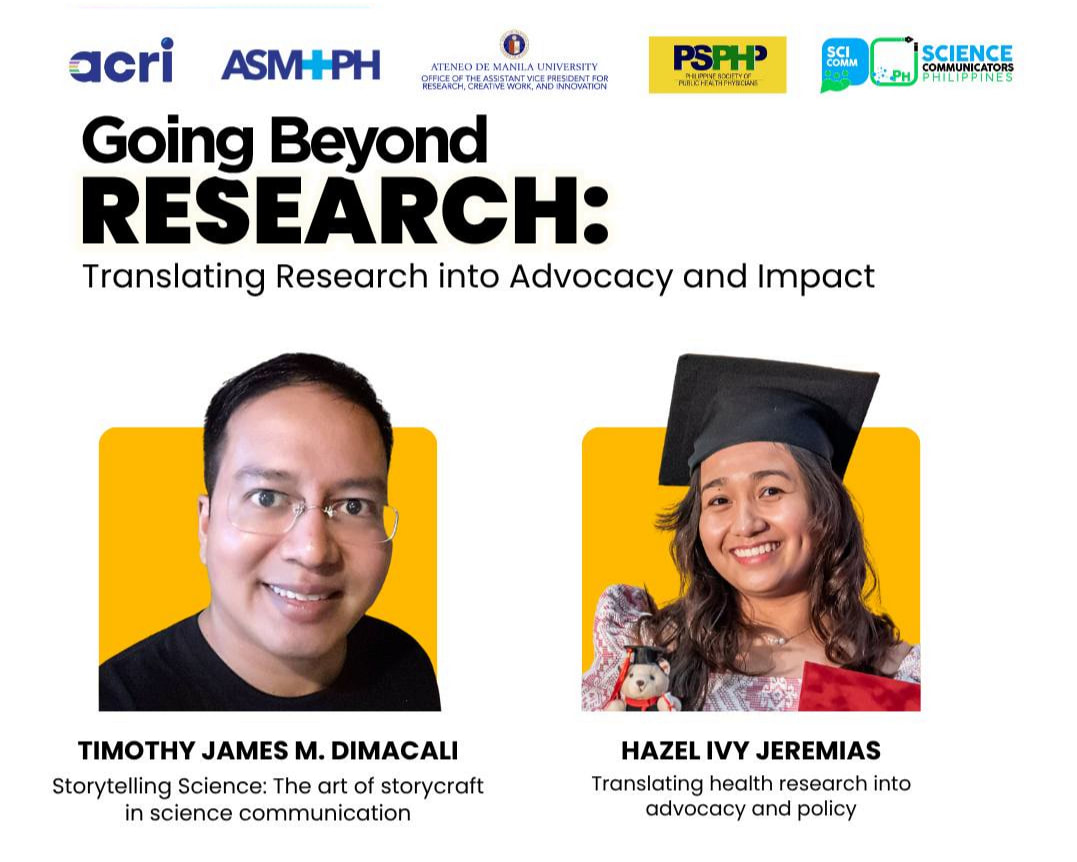 Science Communicators Philippines (SciCommPH) recently joined the Ateneo de Manila University in underscoring the value of research in service of society through the webinar “Going Beyond Research: Translating Research into Advocacy,” which gathered Ateneo faculty, researchers, and communicators from diverse disciplines to explore how scientific knowledge can be better shared, understood, and applied for the public good.
Held last October 8, the event was jointly organized by the Ateneo School of Medicine and Public Health (ASMPH) and its Center for Research and Innovation (ACRI); the Office of the Associate Vice President for Research, Creative Work, and Innovation (OAVP-RCWI); the Philippine Society for Public Health Physicians; and SciCommPH. It forms part of the Ateneo’s and SciCommPH's continuing efforts to build a society that values science as a means of both discovery and dialogue towards informed decision-making. In her opening remarks, ACRI Director Dr. Lourdes Bernadette Sumpaico-Tanchanco welcomed participants by emphasizing that research attains its true value only when it resonates with people’s lives. She urged scholars to “bridge the gap between discovery and lived experience,” stressing that storytelling, advocacy, and collaboration are not peripheral to research but essential to its purpose. “As researchers and scholars, our responsibility goes beyond publication and data,” she said. “It is to ensure that our findings empower communities, inform policy, and inspire action.” Opening the afternoon was Timothy James Dimacali of the OAVP-RCWI and SciCommPH with his presentation, “Storytelling Science: The Art of Storycraft in Science Communication.” Drawing from his experience as a journalist and science communicator, Dimacali explained that storytelling is not a distraction from research but a vital part of it. “People care about people,” he said. “If we can show the human story behind data, we help others see why science matters.” He demonstrated how narratives anchored on empathy and curiosity make complex ideas relatable in fields as diverse as medical research, environmental change, and technological innovation. Hazel Ivy Jeremias of the ASMPH followed with “Translating Health Research into Advocacy and Policy.” She discussed the process of bridging academic work with government and community initiatives, emphasizing that advocacy grounded in evidence can transform public health systems. Jeremias encouraged fellow researchers to “go beyond publication” by sharing findings through partnerships, accessible language, and sustained engagement with stakeholders. Both talks highlighted the value of science communication in medicine and beyond: it is equally essential in fields such as climate science, engineering, the social sciences, and the humanities—areas where data and policy intersect with everyday life. The speakers noted that effective communication helps prevent misinformation, fosters informed citizenship, and ensures that academic research fulfills its social mission of bringing light to the world. In his closing remarks, Dr. Filomeno V. Aguilar Jr. of the OAVP-RCWI lauded ACRI and ASMPH for exemplifying this ideal. “You bring medical science to the people,” he said, “and in doing so, you bring Ateneo’s light to the nation.” He reminded the audience that research finds its true value only when it enlightens minds and uplifts lives. “Science communication,” Dr. Aguilar stressed, “is a civic duty. It builds trust, fosters understanding, and turns knowledge into compassion.” Moderated by Dr. Theo Prudencio Juhani Z. Capeding of the ASMPH, the webinar was capped with a call to strengthen collaboration across disciplines so that the university’s research may continue to illuminate society. In this spirit, he exhorted the participants to go beyond research so as to make every discovery a shared act of service for others. |